
(Why this matters)
Every military reunion exists for one simple reason:
someone volunteered to lead it.
That person—the reunion planner—rarely sought the role for recognition. More often, they stepped forward because no one else would, because they cared about the group, or because they didn’t want to see the reunion fade away.
What many don’t see is the scope of responsibility that comes with that decision.
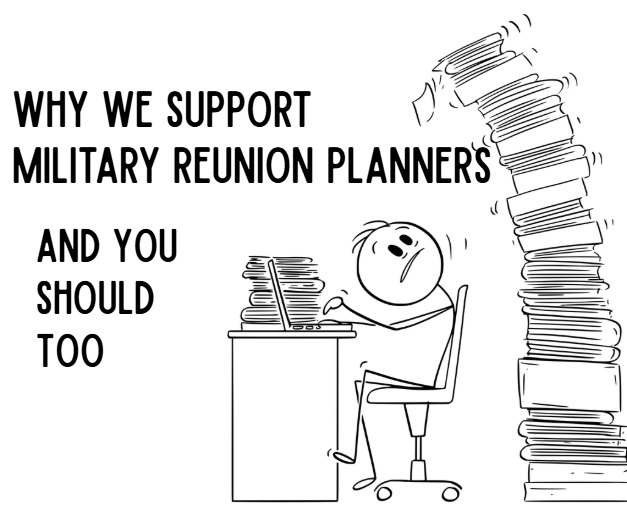
Reunion planners juggle logistics, budgets, contracts, communications, expectations, personalities, emotions, and history. They do this while balancing families, jobs, health, and life—and they usually do it as volunteers. When planners feel unsupported, reunions don’t just become stressful. They become unsustainable.
Supporting the reunion planner is not a courtesy. It is how reunions continue.
It becomes then, not a question of “Why?”, but “Who?” and “How?”. Here are some tips for Reunion Board Associations, Reunion Attendees, and the Hospitality Industry that supports the military reunion market.
Reunion Association Board Members
Share the Load
A reunion should never depend on one person’s endurance. Boards play a critical role in whether a planner thrives or burns out. Support begins with structure, not sympathy. One effective approach is having the planner create a simple task map that lists all reunion responsibilities—registration, finances, communications, vendor coordination, on-site support—and assign ownership, not just “helpers.” When everyone knows what they are responsible for, fewer tasks fall through the cracks, and the planner isn’t left chasing answers. Another key support strategy is rotating these support roles between reunions. Even small rotations prevent burnout and build continuity. When multiple people understand different parts of the process, the reunion becomes more resilient.
Think beyond the current reunion
Supporting a planner also means thinking beyond the current reunion. One effective strategy is identifying a “planner-in-training.” Shadowing allows knowledge to transfer naturally and reduces fear about the future. Keeping records current immediately after the reunion—contacts, vendor notes, timelines—prevents details from being lost and makes future planning easier. Finally, talking about the next reunion early, even informally, helps maintain momentum and shared ownership. Reunions shouldn’t feel like endings—they should feel like continuations.
Trust the Planner’s Experience—Especially When Choosing a Location
Selecting a reunion location is one of the most stressful responsibilities a planner carries—and one of the most scrutinized. These decisions are not made casually. Experienced planners evaluate where attendees live now, overall association and attendee budgets, past reunion locations, travel accessibility, affordability, physical needs of an aging population, and which destinations understand military reunions. Support begins with transparency. When planners share their decision criteria upfront, boards and members better understand the reasoning behind recommendations. It also helps to establish a clear decision window—when feedback is welcome and when the decision becomes final. Endless second-guessing after the fact undermines confidence and delays progress. Perhaps most importantly, once a location is chosen, leaders must back the decision publicly. Mixed messages erode trust and place planners in an impossible position.
Acknowledge the Planner Publicly
Gratitude is not optional. It is retention.
Formal recognition—whether during a banquet or meeting—validates the planner’s work and reminds everyone that leadership is valued. Written appreciation matters too. A note in the program, newsletter, or post-reunion email creates a lasting record of thanks. Peer acknowledgment is equally powerful. When members personally thank planners, it reinforces that their efforts are seen and appreciated.
Reunion Attendees
Participate, Don’t Just Attend
Support doesn’t begin at check-in. It begins months earlier. One of the simplest ways members can support a planner is by adopting an “early bird equals support” mindset. Early registrations reduce financial risk, improve negotiating power, and lower stress. When members delay, planners are forced to make decisions without reliable numbers.
Another meaningful contribution is micro-volunteering. Instead of vague offers to “help if needed,” members can take on small, defined tasks—welcoming attendees, collecting photos, managing raffles, or assisting with registration. These tasks may seem minor, but collectively they relieve enormous pressure.
Peer encouragement is equally powerful. When members personally reach out to one or two service mates to encourage attendance, the planner is no longer carrying recruitment alone. Reunions thrive when participation becomes a shared responsibility.
Respect the Emotional Side of Reunions
Military reunions are about reconnection—and sometimes loss.
Supporting planners means recognizing that not every moment needs to be programmed. Building in unstructured time allows conversations to unfold naturally. Free time is not wasted time—it is often the heart of the reunion. Flexibility is also essential. Not every attendee will participate in every activity, and that’s okay. Support means allowing space for different comfort levels and energy levels.
Finally, it’s important to normalize emotion. Joy, grief, laughter, reflection—they all belong at reunions. Planners should not feel responsible for managing emotions, only for creating space where they are allowed.
CVB and Hotel Partners
Understand the Human Behind the Contract
Reunion planners are not professional, paid meeting planners. They are volunteers often navigating unfamiliar processes.
One of the most impactful ways CVBs and hotels can support planners is to become knowledgeable about what the military reunion market is all about. (Call the Military Reunion Network to learn more about the overall market). Listen to what is important to the planner. If they mention having a memorial service at a park for example, share some location ideas and a vendor that can provide an environmentally friendly wreath.
Simplifying and targeting proposals is another powerful form of support. Create and use a military reunion proposal template that includes the information and policies these events require. Supporting alcohol in the hospitality space or dealing with attrition are two issues that come up frequently. Clear pricing and plain language help planners make confident decisions. Overly complex and unclear proposals increase decision fatigue and slow progress.
Finally, support sometimes looks like checking in without selling. A simple “How’s planning going?” email builds trust and partnership. Planners remember who treated them like people, not transactions.
Reduce Decision Fatigue Wherever Possible
Reunion planners make hundreds of decisions. Support means reducing unnecessary ones. Presenting two or three strong recommendations allows planners to move forward confidently without feeling overwhelmed.
Anticipating common questions is equally helpful. Parking, accessibility, meal timing, AV needs—answering these upfront prevents planners from having to ask later, often under pressure.
Providing a clear planning timeline is another essential support tool. Knowing what decisions need to be made—and when—reduces anxiety and second-guessing.
Uncertainty is exhausting; clarity is empowering.
Why This Matters
Reunions don’t end because people stop caring. They end because planners get exhausted. When boards, members, attendees, CVBs, and hotels actively support the reunion planner, stress decreases, decisions are made earlier, attendance improves, and reunions continue. Supporting the planner isn’t extra work. It’s the work that keeps reunions alive.
Like this article? Sign up for Quick Tip Tuesday for more Sign up for our Newsletter – The Military Reunion Network
